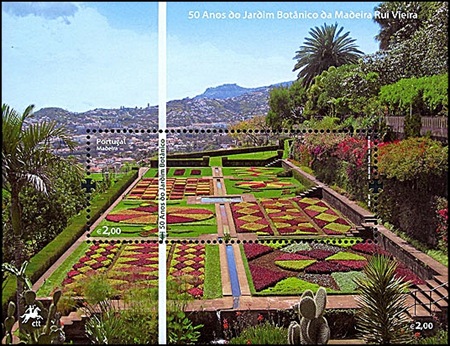
Portugal Post released the stamp series feature the Madeira Botanical Garden on April 30th, 2010 . The issued stamp consist of one set of four single stamp and two souvenir sheet. All stamps depicted the view of beautiful Madeira Botanical Garden.
The Madeira Botanical Garden is a scientific institution devoted to the study and conservation of the exceptionally rich flora and vegetation of the archipelagos of Madeira and Selvagens, but it is also a pleasant place to enjoy and get to know the diversity of the plant kingdom.

-
The Botanical Garden, founded on April 30, 1960 by agronomist Rui Vieira, belongs to the Regional Government of Madeira; it covers an area of approximately 8 hectares and has an average of 330 000 visitors annually. It is located in Funchal, on the Quinta do Bom Sucesso or Quinta Reid, which dates back to the middle of the 19th century.
In this scientific institution are implemented systematic studies on vascular and avascular plants, molecular biology, reproductive biology, and conservation biology and vegetation ecology. The research is fundamental to know the diversity of the flora and vegetation of Madeira, in order to establish strategies for the conservation of the species and the vegetal communities.

The occupation of the islands of the archipelagos of Madeira and Selvagens by Man, with the introduction of animals and plants, caused the destruction or changes to many natural habitats. As a consequence, some plant species are presently threatened with extinction or are restricted to slopes and other rather inaccessible places. The Botanical Garden of Madeira plays an active role in this regard, through inventorying and monitoring actions of these species.
In the Seed Bank of the Botanical Garden of Madeira, created in 1994, are stored the seeds of the most endemic species of the archipelagos of Madeira and Selvagens and of other native species. The collection of seed is sometimes extremely difficult since many of the populations appear in almost inaccessible places.
Other actions developed by the Botanical Garden of Madeira are the propagation of indigenous species, especially rare endemism's threatened with extinction. Most of the species are propagated by seeding, in nurseries and greenhouses, but in some cases it is necessary to resort to stalk cuttings and in vitro culture. At a later stage actions are carried out to reintroduce and reinforce the populations in the nature, especially species with a reduced population.
Besides being a centre for research and conservation of the flora of Madeira, the Botanical Garden is also an educational activity centre. The institution carries out several divulgation and awareness raising actions concerning the flora and vegetation of Madeira and the need for their conservation. The activities are mainly aimed at students from the different educational levels and include guided visits to the Garden or field trips, actions involving planting native species in the nature, eradicating invading plants in the natural habitats, among other.
The Botanical Garden is also an adequate place for hosting various cultural activities, such as concerts, dance, theatre and painting. (Resources : Portugal Post info)


