Showing posts with label Fauna. Show all posts

Saturday, 6 October 2012

Unique Birds of Malaysia


Malay Post issued the stamp set of fauna series  features the unique birds on January 21, 2009. The issue comprises of three postage stamps which   depicted the birds are found in Malaysia, such as : Merak Pongsu (Polyplectoron malacense), Murai Bersiul Gunung (Myophonus robinsoni), Milky Stork (Mycteria cinerea) .


The Malaysian Peacock-Pheasant (Polyplectron malacense) is a medium-sized pheasant of the galliform family Phasianidae. It is one of the shortest-tailed peacock-pheasants. Adult males are about 50 cm long, about half of which is made up by the tail.


A shy and elusive bird, the Malaysian Peacock-Pheasant is endemic to lowland forests of the Malay Peninsula form the Isthmus of Kra region southwards. At one time, this species was widespread in Malaysia and Thailand, and reported from southern Myanmar, Sumatra and Singapore.It inhabits mainly dipterocarp rainforest up to 150 m ASL  , rarely occurring even as low as 300 m ASL

Monday, 23 January 2012

Owls of Luxembourg

 
Luxembourg Post issued the fauna stamp series feature owls species on March 8, 1999. The issue stamps composed of three postage stamps depicts Tawny Owl, Barn Owl, Eagle Owl with different nominal face value.

The Tawny Owl (strix aluco)
image
The Tawny Owl is certainly the most frequent owl in  regions of Luxembourg.The tawny owl is nocturnal so it is often heard calling at night, but much less often seen. In the daytime, you may see one only if you disturb it inadvertently from its roost site in woodland up against a tree trunk or among ivy. It breeds in mixed woodlands as well as in urban parks.
The Tawny Owl is an owl the size of a pigeon. The distinctive of this bird are  a rounded body and head, with a ring of dark feathers around its face surrounding the dark eyes. It is mainly reddish brown above and paler underneath. 

The Tawny Owl feeds Small mammals and rodents, small birds, frogs, fish, insects and worms . Its voice is a classic melodious hoot, often heard in horror films at the nearby cemetery. To hear the male and female calling during springtime in a shallow night is an outstanding experience for everybody.

Monday, 21 November 2011

Nature of Australia -2002

In year 2002, Australia Post focus designed on the Great Sandy Desert (GSD) located in Western Australia and Northern  Territory. Australia is the driest continent in the world. Thirty five per cent of continent is effectively desert.
The issue of the Nature  series comprised of 4 stamps depicts the Great Sandy Dessert, and flora fauna lived in there such as: desert star flower, bilby, and thorny devil.


img725


The Great Sandy Dessert (GSD)  covers about  395,250 square kilometres or 5.1 per cent of the continent and is the largest desert in Australia.The GSD consist of mainly of red sandy plains; patches of desert oak and spinifex grass are common features.

Wednesday, 19 October 2011

“FOREST FAUNA AND FLORA” - 2009

Lithuania Post issued the stamp series features the Forest Fauna and Flora from the Red Book of Lithuania on September 11, 2009. The stamps issued comprised of 2 single stamps and depicted Stock Pigeon and Lesser Emperor. Artist designer of stamps is A. Ratkevičienė. 


image


Stock Pigeon (Columba oenas) is a member of the family of Columbidae, doves and pigeons. The Stock Pigeon constantly inhabits the Curonian Spit and Kazlų Rūda forests in Lithuania. Larger colonies of these birds are distributed in the southern and eastern regions of the country – Dainava, Rūdninkai, Lavoriškės, Labanoras forests where pine trees dominate.
The Stock Pigeon generally inhabit mature pine forests and mixed forests. It nests in a naturally rotten hole in a tree. The eggs (usually 2) are laid in late April/early May. The Stock Pigeon is capable of raising 2–3 broods per season. Most of its food is vegetable.
Cutting down hollow dry trees and mature forests and abundance of pine martens pose the greatest threat to the Stock Pigeon. Since 1970, this species is listed in the Red Data Book of Lithuania, as well as the Berne Convention, Annex III.

Lesser Emperor (Anax parthenope) is a dragonfly of the family Aeshnidae. It is found in Ignalina, Lazdijai, Molėtai, Prienai, Trakai, Ukmergė, Varėna, and Vilkaviškis districts in Lithuania. The Lesser Emperor usually inhabits the surrounding areas of forest lakes and ponds.
The female of the species insert their eggs into water plants’ stems. Larval development depends on water temperature and usually takes 1–2 years. The Lesser Emperor is most commonly seen from May to August. It feeds on insects.
Water pollution and recreational activities in its natural habitats are major threats to the Lesser Emperor. Since 1989, this species is under protection in Lithuania.


Tuesday, 7 June 2011

Anegada Flamingo

The Flamingo Pond, Anegada is home to the Flamingos which are the second largest of its species, often growing to 5 feet tall. The Flamingo Pond, Anegada is located in the central area of Anegada Island and now become as one of the most popular spots of sightseeing in the area. The flamingos and other sea birds have been re-established at this protected pond area and hence the name.

brv199501l

The Flamingo Pond in Anegada is the largest of the four salt ponds that occupies approximately one quarter of Anegada's total land mass. This fragile ecosystem maintains a small but growing population of Caribbean Flamingos which were successfully reintroduced to Anegada in the year 1992.


brv199502l


Due to unrestricted hunting, the native flamingos in the British Virgin Islands were wiped out. The Biologists reintroduced a flock of 20 flamingos from Bermuda to Anegada in the year 1992. This project has proved successful as the flock has grown to more than 50 birds since they were introduced.


brv199503l

The project also aimed at attracting the other migrating species in hopes of increasing the gene pool in the area. These vertebrates do not reach sexual maturity until they are three to six years of age and generally only lay one or two eggs in a one year period after mating. The Female lots usually only reproduce every other year. Flamingos frequently mate for life and both male and female take turns in incubating their egg.


brv199504l


Western Anegada is actually famous for the Flamingo Pond Bird Sanctuary, which is a salt pond and mangrove area. This area is home to the various species of birds like waterfowl, a variety of herons, terns, osprey, and snowy plovers.


brv199599l
 
The British Virgin Island National Parks Trust has accepted Flamingo Pond as a bird sanctuary. The other bird species such as terns, ospreys and egrets can be seen nesting and feeding in the area. Whenever you come here with your family or friends you can spot the flamingos wading on the far north side of the pond.

Monday, 9 May 2011

Flying squirrel

 
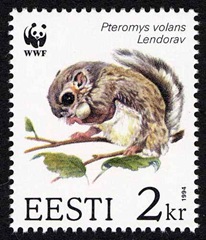
The Estonia Post has collaborated with WWF organization issued the stamp series features  the  endangered species, Pteromys volans Lendorav  or the Flying squirrel on June 27th 1994. The issuance consisted of 4 single stamps with differ face value and one First Day Cover. All issuance  stamps have marked  a logo of WWF.

img_735
The Siberian Flying Squirrel (Pteromys volans) is an Old World flying squirrel occurs throughout Scandinavia, Russia, across northern Asia to Siberia and south along the Pacific coast of northern China including the Korean Peninsula and northeast China. Pteromys volans is the only species of flying squirrel found in Europe.It is considered vulnerable  species  within the European Union where it is found only in Finland and Estonia.Possibly extinct in Belarus and Lithuania.


img_734
Pteromys volans have distinct, large, black eyes. The length of the head and body is 120-228 mm with a 9–14 cm long flattened tail . A female Siberian Flying Squirrel weighs about 150 grams, the males being slightly smaller on average.The coat is grey all over, the abdomen being slightly lighter than the back, with a black stripe between the neck and the forelimb. Pteromys volans do not have a membrane between their hind limbs and the base of their tail. Their limbs are relatively short and thick and their hind feet are significantly larger than their forefeet.


img_736 
Pteromys volans are basically herbivores.The diet  consists of leaves, seeds, cones, buds, sprouts, nuts, berries and occasionally bird eggs and nestlings. In the summer, they feed on green plants, young branches, berries and seeds. During the winter months, P. volans consume nuts, catkins, pine cones, and pine needles.


img_737

Pteromys volans are a social species; many can be found together in a single tree. They build nests in vacant tree holes or in the junction of a branch and the trunk. Nests are often inhabited by pairs.Siberian Flying Squirrels preferentially build their nest in holes made by woodpeckers, but they may also nest in birdhouses if the size of the entrance is appropriate. The nest consists of a pile of soft materials (preferably soft beard lichen) into which the squirrel burrows. Pteromys volans or a Siberian Flying Squirrel can live up to about five years.


image


Siberian Flying Squirrels favor old forests with a mix of conifers and deciduous trees.It prefers mature spruce-dominated forests with a significant proportion of deciduous trees, especially aspen Populus tremula, birch Betula sp. and alder Alnus sp. They are mostly nocturnal, being most active late in the evening, although females with young may also feed during the day.They are found from lowlands to montane regions. Siberian Flying Squirrels do not hibernate, but in the winter they may sometimes sleep continuously for several days.

As shy and nocturnal animals, Siberian Flying Squirrels are seldom seen. The most common sign of their presence are their droppings, which resemble orange-yellow rice grains and are often found beneath or on top of their nest.In the summer, they are active from a half hour to an hour after sunset until dawn. Most of this time is spent searching for food.During the winter, the activity  is shorter and  consume less food.

Modern intensive forestry and logging are the major threats to this species .Pteromys volans are hunted for commercial use of their fur..Pteromys volans are preyed upon by martens, owls, ermines, and cats.The species continues to decline in many parts of its range owing to loss of old-growth mixed forests.Possibly extinct in Belarus and Lithuania.

Related Posts Plugin for WordPress, Blogger...