Showing posts with label Australia. Show all posts

Monday, 21 November 2011

Nature of Australia -2002

In year 2002, Australia Post focus designed on the Great Sandy Desert (GSD) located in Western Australia and Northern  Territory. Australia is the driest continent in the world. Thirty five per cent of continent is effectively desert.
The issue of the Nature  series comprised of 4 stamps depicts the Great Sandy Dessert, and flora fauna lived in there such as: desert star flower, bilby, and thorny devil.


img725


The Great Sandy Dessert (GSD)  covers about  395,250 square kilometres or 5.1 per cent of the continent and is the largest desert in Australia.The GSD consist of mainly of red sandy plains; patches of desert oak and spinifex grass are common features.

Thursday, 3 November 2011

Farming Australia: Native Plant

The stamps issued by Australia Post on May 17th 2011,  represents four of Australia’s largest native horticultural industries: eucalyptus oil, honey, macadamia nuts and tea tree oil. All four commercially cultivated industries have an export market. Designer of these stamps is Wayne Rankin .


Eucalyptus Oil:
image
The Eucalyptus oil industry, which began in 1852 in Victoria, has been called the first truly Australian industry.
Today Australia accounts for only 10 per cent of the total world production, but it is regaining some of the market share for medicinal oil lost to China.

Australian oil derives from the Blue Mallee, grown mainly in central Victoria with some production in NSW. Eucalyptus oil has a wide range of industrial and medicinal uses.

Australian Honey:
image

The honey industry is worth about $50 million annually of which around 50 per cent is exported. Bees are declining worldwide and consequently. Australian honey is highly sought after.


While the honey bee Apismellifera is not native to Australia (introduced in 1822) 80 per cent of honey is derived from native flora such as eucalyptus flowers. Honey is produced in every state and territory, with 45 per cent coming from NSW.


Macadamia Nuts:
image
 
Australia is the world's largest producer of macadamia nuts, with the industry currently worth around $110.7 million.
 
NSW accounts for more than 60 per cent of production and Queensland for around 40 per cent. There is also a tiny industry in Tasmania. Around 75 per cent of Australian macadamia nuts are exported. 


Tea Tree Oil:
image
A potent natural compound with antibacterial, anti-fungal, anti-inflammatory and antiviral properties.
Tea tree oil is our second most successful native horticultural industry (after macadamias), earning around $30 million annually.
 
The tea tree Melaleuca alternifolia is native to the northern rivers region of NSW. Main Camp in northern NSW is the world's largest tea tree plantation. (Resources: Australia Post)
 

Wednesday, 2 November 2011

Australian World Heritage Sites

On 25th of  May 2010, the Australia Post has issued the stamp series  features four UNESCO World Heritage sites in Australia. They are the Purnululu National Park in Western Australia, Kakadu National Park in the Northern Territory, Mount Warning in the Gondwana Rainforests, and the Tasmanian Wilderness.
 
image

The Gondwana Rainforests of Australia were first inscribed on the World Heritage List in 1986. They include discontinuous rainforest that occurs in New South Wales and south-east Queensland, surrounded by eucalypt forest and agricultural lands. They contain an almost complete record of the major evolution of plant life on Earth.


image

The Tasmanian Wilderness is one of three temperate wilderness areas remaining in the southern hemisphere that covering approximately 20 per cent of the state. It contains rocks from almost every geological period and it is recognised as an “International Centre for Plant Diversity”.


image
 
Purnululu National Park in Western Australia was inscribed on the UNESCO World Heritage List in 2003 as an outstanding example containing the major stages in the Earth’s evolutionary history, superlative natural phenomena, and areas of exceptional natural beauty. Found in the isolated east Kimberley region, it covers almost 2,400 square kilometres.


image

Kakadu National Park was inscribed on the World Heritage List in three stages over 11 years, and is included for its natural and cultural values. Kakadu is located in the tropical north of Australia, some 130 kilometres east of Darwin, and covers 19,804 square kilometres.


Monday, 31 October 2011

Australian Beaches - International Stamps


Australian Beaches are beautiful  and  inherent with “ 3 S”, Sun, Sand  and Surf . Australia is  renowned for these, and three of its most beautiful beaches are shown on these stamps that issued by Australia Post on June 28, 2011. The stamps designed by Janet Boschen. 


imageBay of Fires, Tasmania
The Bay of Fires in north-eastern Tasmania is located within Mt William National Park. The rocks and stones along the beach are visible reminders of the land bridge once connecting Tasmania to the mainland. It was named by Captain Tobias Furneaux, in 1773, when he noticed numerous fires along the coast. 


image
Cape Tribulation, Queensland
Cape Tribulation, in the Wet Tropics World Heritage Area in northern Queensland, is in one of the most biologically diverse areas in the world. The Eastern Kuku Yalanji Aboriginal people are the traditional owners of this area. The Cape was named by Lieutenant James Cook after his ship, Endeavour, was holed on a reef in 1770.


image
Hellfire Bay, Western Australia
Hellfire Bay is located east of Esperance in Cape Le Grand, one of Western Australia’s best known and most spectacular national parks. The park is named after Le Grand, an officer of the L’Esperance, one of the ships in a French expedition that sailed in 1792. 


Tuesday, 6 September 2011

Australian Botanic Gardens

Australia Post has issued the stamp  features five of Australia's major botanic gardens on September 12th, 2007. The stamps celebrate the beauty of plants through differing seasons and the diversity of specific garden types.
Botanic gardens can be traced back to the medicinal teaching collections of the 16th century in Europe and flourished with exploration and colonial empire-building. Seeds and plants were sent back to the gardens from all over the world and early Australian governors and settlers viewed the establishment of botanic gardens as a part of civilised living and colonial advancement. It is no surprise then that land was designated for botanic gardens in many regional towns as well as the cities.
 
image
Botanic Gardens of Adelaide
The 1837 plan of Adelaide showed an area set aside for a botanic garden which was finally opened in 1857. Many of the trees were planted in the 19th century including those in the Moreton Bay Fig Avenue (1866), Araucaria Avenue (1868), and Plane Tree Ring (1883). The Garden specialises in scientific and educational displays of ornamental plants, both exotic and native.
 
image
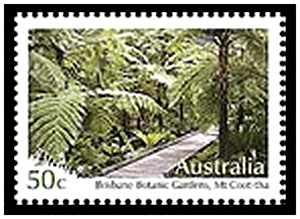
Brisbane Botanic Gardens, Mt. Coot-tha
These subtropical Gardens cover 52 hectares and are located only seven kilometres from the city centre. They were opened in 1976 and are home to over 20,000 plants. Specialty gardens include the Japanese Garden, the Australian Plant Communities Garden with its lake and totems, and the Tropical Display Dome.
 
image
Royal Botanic Gardens, Melbourne
The gardens were established in 1846 but it wasn't until 1857 that the first full time Director, Ferdinand von Mueller was appointed. Mueller was to become one of the most acclaimed botanists of the 19th century. He established the Garden's scientific centre, the National Herbarium of Victoria, and amassed an extraordinary range of plants from every corner of the world.

image
Royal Botanic Gardens and Domain, Sydney
A 64 hectare oasis sits in the heart of the city and occupies one of Sydney's most spectacular positions on the harbour The Garden was established in 181 Band is the oldest scientific institution in Australia home to an outstanding collection of plants, which include endangered species such as the ancient Wollemi Pine rediscovered in 1994. Only 100 of these adult trees grow in the wild of the Blue Mountains in NSW.
 
image
Kings Park and Botanic Garden, Perth
Right on the edge of Perth's city centre, the Garden and Park cover 400 hectares and is notable for its remarkable collection of wildflowers. Nearly two-thirds of the area is natural bushland and has a balance of superb cultivated gardens and open recreational areas. The park was gazetted as a public park in 1872 and renamed Kings Park in 19W in honour of King Edward VII, after a visit to Perth by his son, the Duke of York (later King George V).
Technorati Tags: ,

Thursday, 1 September 2011

Lake Eyre of Australia

 
Australia Post has issued the stamp series feature Lake Eyre, the unique landscape of  great salt lake of tectonic origin,and its vast and changing environment has been beautifully captured in these stamp designs. The stamps issued in four nominal value on April 4th, 2011.The four stamps in the issue include one domestic rate stamp - The dry (60c) and three international rate stamps - New growth ($1.55), Bird life ($2.25) and In flood ($3.10). 
 
Lake Eyre lies asymmetrically in the south-western corner of the closed inland drainage basin in the heart of the Australian continent. Lake Eyre is the centre of the vast Lake Eyre Basin located 700km north of Adelaide in the deserts of central Australia. With an area of 1,140,000 square kilometres Lake Eyre Basin is one of the largest areas of internal drainage in the world. Some parts of Lake Eyre are 15.2 metres below sea level making it the lowest point in Australia. 

During the dry season there is usually some water, however Lake Eyre is primarily characterised by great salt pans. On the rare occasions that it fills to capacity, Lake Eyre becomes the largest salt lake in Australia. Water covers the lake on average about once every eight years and has filled to capacity only three times in the last 150 years.
 
image
The Dry:
Lake Eyre is located in the central Australian desert and is characterised by great salt pans. 


image
New growth:
Desert areas previously ravaged by dust storms are now lush and green. 


image

Bird Life:
The higher rainfall has prompted a variety of birds to migrate back to the area. 


image

In Flood:
In strong La Niña years the lake can fill. The rainfall of 2010 sent flood waters into the catchment basin.


The recent high rainfall has filled the vast floodplains around Lake Eyre creating wetlands brimming with life. In drought there is usually no sign of bird life and their return remains a mystery for scientists. Pelicans have returned to rivers and waterholes all around Lake Eyre to breed. (Resources: Australia Post News)

Technorati Tags: ,
Related Posts Plugin for WordPress, Blogger...