Showing posts with label Bird. Show all posts

Sunday, 4 November 2012

Fiji Goshawk


Post Fiji Limited  proudly to release a set of four stamps feature the endemic bird of prey on  September  10, 2002.  The issued stamps depict the Fiji Goshawk as endemic bird to Fiji, presenting the chicks to the adult bird. These are beautiful bird stamps.
 
http://d2cdm2jef6kgc7.cloudfront.net/stamps/2002/FJ/FJ022.02.jpg
The Fiji Goshawk (Accipiter rufitorques) is a species of bird of prey in the Accipitridae family. It is endemic to Fiji, where it occurs on the larger islands of Viti Levu, Vanua Levu, Taveuni, Kadavu, Gau and Ovalau.

Their habitat is  a range of wooded habitats in Fiji, from natural rainforest to coconut plantations and urban gardens and parks.


Monday, 29 October 2012

Sea Eagle of Lithuania Red Book.


On October 08, 2011, Lithuania Post Office issued one stamp features a rare bird species  which listed in the Lithuanian Red Book, White-tailed Eagle also called Sea Eagle or Haliaeetus albicilla.


White-tailed Eagle (Haliaeetus albicilla)  is a large bird of prey in the family Accipitridae. Lithuania's first sea eagle's nest was found in  Čepkeliai Reserve.

The territory of the White-tailed Eagle ranges between 30 and 70 km², normally in sheltered coastal locations. Sometimes they are found inland by lakes and along rivers. Nests in trees growing close to the open areas: wetlands , harvesting, forest parks. They feed on fish, water birds, mammals.

Saturday, 6 October 2012

Unique Birds of Malaysia


Malay Post issued the stamp set of fauna series  features the unique birds on January 21, 2009. The issue comprises of three postage stamps which   depicted the birds are found in Malaysia, such as : Merak Pongsu (Polyplectoron malacense), Murai Bersiul Gunung (Myophonus robinsoni), Milky Stork (Mycteria cinerea) .


The Malaysian Peacock-Pheasant (Polyplectron malacense) is a medium-sized pheasant of the galliform family Phasianidae. It is one of the shortest-tailed peacock-pheasants. Adult males are about 50 cm long, about half of which is made up by the tail.


A shy and elusive bird, the Malaysian Peacock-Pheasant is endemic to lowland forests of the Malay Peninsula form the Isthmus of Kra region southwards. At one time, this species was widespread in Malaysia and Thailand, and reported from southern Myanmar, Sumatra and Singapore.It inhabits mainly dipterocarp rainforest up to 150 m ASL  , rarely occurring even as low as 300 m ASL

Monday, 5 December 2011

Herons of the Reef - Vanuatu

 
van200704l
Vanuatu Post has released the heron stamp series, features Reef Heron  or Ardea (Egretta) sacra on February 07, 2007. Sometime call as Pacific Reef heron.
This issued stamp is represented in miniature sheet, consist of 5 postage stamps which depicts its life since the chicks till adult.


The species displays an unusual, non-sexual dimorphism, with some members having entirely white plumage and others (the larger portion) being charcoal-grey. The reason for the color variation or "morph," is unknown, though it is most commonly thought to be related to camouflage.

Tuesday, 7 June 2011

Anegada Flamingo

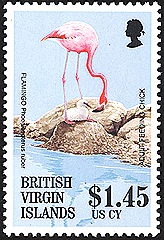
The Flamingo Pond, Anegada is home to the Flamingos which are the second largest of its species, often growing to 5 feet tall. The Flamingo Pond, Anegada is located in the central area of Anegada Island and now become as one of the most popular spots of sightseeing in the area. The flamingos and other sea birds have been re-established at this protected pond area and hence the name.

brv199501l

The Flamingo Pond in Anegada is the largest of the four salt ponds that occupies approximately one quarter of Anegada's total land mass. This fragile ecosystem maintains a small but growing population of Caribbean Flamingos which were successfully reintroduced to Anegada in the year 1992.


brv199502l


Due to unrestricted hunting, the native flamingos in the British Virgin Islands were wiped out. The Biologists reintroduced a flock of 20 flamingos from Bermuda to Anegada in the year 1992. This project has proved successful as the flock has grown to more than 50 birds since they were introduced.


brv199503l

The project also aimed at attracting the other migrating species in hopes of increasing the gene pool in the area. These vertebrates do not reach sexual maturity until they are three to six years of age and generally only lay one or two eggs in a one year period after mating. The Female lots usually only reproduce every other year. Flamingos frequently mate for life and both male and female take turns in incubating their egg.

brv199504l


Western Anegada is actually famous for the Flamingo Pond Bird Sanctuary, which is a salt pond and mangrove area. This area is home to the various species of birds like waterfowl, a variety of herons, terns, osprey, and snowy plovers.


brv199599l
 
The British Virgin Island National Parks Trust has accepted Flamingo Pond as a bird sanctuary. The other bird species such as terns, ospreys and egrets can be seen nesting and feeding in the area. Whenever you come here with your family or friends you can spot the flamingos wading on the far north side of the pond.
Related Posts Plugin for WordPress, Blogger...